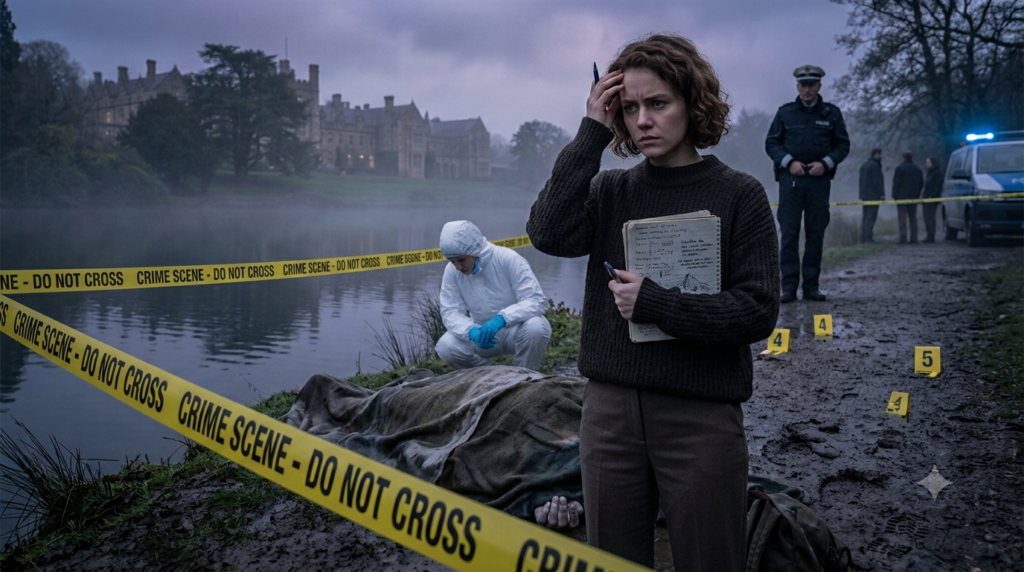
Ever wondered why book reports are so incredibly difficult integrate? You’re definitely not alone. We are student teachers at the Heidelberg University of Education and even though we have no experience in integrating book reports in class, we tried new innovative ways to structure a book review. On our way there we came across podcasting and decided to create a podcast. We may not be experienced podcasters (or teachers for that matter), we wanted to be brave and try to inspire other student teachers or even teachers to try and integrate a book into their own English lessons.
In this episode of The Foreigners we are diving deep into the book „Young, Gifted and Dead“. Whether you’re seasoned pro or just getting started, this conversation will help you navigate this difficult task.
What We actually talk about in this episode:
- Short info about the book and author
- Quickly cover the plot
- our favorite parts of the book
- Why and how it could/ should be used in the English classroom
Featured in this episode:
- Tatjana Radunovic and Ilker Soylu
- „Young, Gifted and Dead“ by Lucy Carver
Ready to listen? Hit play and enjoy!
Podcast-Transcript:
[0:00 – 0:11]
Tatjana: Welcome to the podcast you didn’t ask for, but somehow ended up needing it. Two people, one mic and absolutely no qualifications – let’s begin. I’m Tatjana
[0:11 – 0:37]
Ilker: And I’m Ilker, and we’re here to talk about why this book deserves to be in your English classroom. Our seminar is called Crip Lit, and we talk about topics that concerns neurodivergent people. In this case, our book is in some way written about a neurodivergent person, but in a special way. We will talk about that in a moment and share our experience and opinion about this book with you. And one thing to know before we start is that there will be some spoilers about the book. But lets’ get started.
[0:37 – 1:28]
Tatjana: So, the book we read, and want to talk about is called Young, Gifted and Dead. The author is Lucy Carver, and she is a young adult author who writes mystery and thrillers. We’d like to give you a little summary of this book, and later on we’ll talk about it in more detail. In this book there’s a girl called Allysa. She has a photographic memory and that’s the thing that makes her special. She starts at a new high-society college, and as we know, roommates are always paired up in dorms. Her roommate is called Lilly and Lilly is a girl who was found dead in the lake next to their school. Alyssa also has another friend named Paige. Allysa is now on a mission: with her photographic memory, she wants to investigate and find out who killed Lilly and why it happened.
So Ilker, what’s a moment in this book which surprised you?
[1:28 – 2:00]
Ilker: So, what caught me off guard was the sheer darkness of the underlying conspiracy. It starts as a typical boarding school mystery, seemingly centered around students’ drama, a tragic suicide, and teenage rebellion. But it escalates into an unsettling, highly coordinated neo-Nazi ring involving respected staff members like the bursar and even the PE teacher. The reveal of the silver box containing teeth extracted from historical victims alongside Lily’s molar adds a gruesome twist that I did not see coming for a young adult thriller.
[2:00 – 2:37]
Tatjana: I get your point and I’m on your side in this case. But one thing that surprised me was also Lilly’s background – her complicated relationship with her family, the fact that she was pregnant, and no one knew, and her mental disorder, which was bipolar. And of course, the Nazi plot you mentioned. So yes, those are the things that surprised us.
As for what I enjoyed the most about reading this book, it was the flow it had. I never had a moment while reading where I didn’t want to keep going, because there was always something happening, always a point where something had changed or was about to change.
[2:37 – 3:02]
Ilker: So, what I enjoyed the most was definitely the pacing and the clever mechanics of the plot. I think the author does a fantastic job of giving you pieces that seem vague at first, like the green shoots truck, the random mugging at the train station, and the weird behavior of the school staff and snapping them all together into a terrifying picture in the final act keeps you hooked until the last sentence. But what about a moment of a character you liked?
[3:02 – 3:03]
Tatjana: Oh, good question Ilker.
[3:03 – 3:04]
Ilker: Thanks.
[3:04 – 3:23]
Tatjana: Alyssa is the character I liked the most, because of her courage and her determination to discover what happened to her roommate. She essentially sacrificed her own safety just to get justice for Lilly and find out what happened to her, and along the way she eventually found love and acceptance. What about you, Ilker?
[3:23 – 3:55]
Ilker: The Character:Jayden (and his dog, Bolt). He is the ultimate hero. He doesn’t care about school politics, he doesn’t like the cops, and he operates entirely on “gut instinct” because certain people just make his skin crawl. He acts as a grounded, loyal counterweight to the corrupt, elite world of St. Jude’s. The Moment: When Harry tries to execute his twisted plan to drown Alyssa and frame her, and Bolt leaps out of the pitch-black darkness to save her life. It’s an incredibly cinematic, heart-pounding rescue that perfectly breaks the tension.
[3:55 – 4:09]
Tatjana: Yes, and the next question we want to raise our audience is: you probably know what happens in the book by now, but why should we bring it into our English class? That’s the next point we want to talk about.
[4:09 – 5:01]
Ilker: Let’s talk about why it works in an English classroom. First off, it explores how people in positions of trust, like teachers or administrators, can hide biases and criminal behavior behind a clean-cut image. Also, there’s grief and friendship, so Alyssa and Paige’s fierce loyalty to Lilly, risking their own safety to find the truth, is highly relatable for young adults who put massive importance to their friends. The book also directly tackles tension between doing what is right versus just blindly following institutional authority, like when the headmaster is acting like he doesn’t know anything. Not to forget, the style heavily relies on rapid dialogue, high stakes tension and short, punchy chapters. It’s an excellent tool for teaching students about narrative tension and how to structure a thriller. Lastly, phrases like a leopard doesn’t change its spots offers great opportunities to discuss idioms, metaphors and tone.
[5:01 – 5:26]
Tatjana: Yes, and another question we’re asking ourselves is: what questions does the book raise, and what kind of discussion potential does it have? So, we asked ourselves- when is the right time to break the rules and find out the truth? And why do you think the institutions like school tend to cover up scandals rather than face them? So, what do you think Ilker? How does the book connect to current issues?
[5:26 – 5:46]
Ilker: I think it connects very well. It directly mirrors modern anxieties regarding the resurgence of underground echo chambers, hate groups and radicalization among young people. Also, the role of the investigative journalists, Kamko and Emily archer, opens the door to discussions about the power of the press, exposés and media ethics.
[5:46 – 5:56]
Tatjana: Right, but we are talking about school and how to bring this into an English class. What about the students- how might they connect with the book? Do you think students would find it fun to read?
[5:56 – 6:04]
Ilker: Absolutely. It has the DNA of a classic boarding school mystery but with high stakes plot. What do you think? Is it emotional?
[6:04 – 6:15]
Tatjana: Yes, I’d say so, because the idea of losing your dearest friend and risking your life to learn the truth is emotional just to think about. So, would you say it’s thought-provoking?
[6:15 – 6:24]
Ilker: 100%. It forces students to look past the surface of perfect institutions and ask hard questions about complicity and silence.
[6:24 – 6:44]
Tatjana: Our dear listeners, we’re wrapping up this episode in a few seconds, but here are some questions we’d like you to think about and answer: Would you read this book in your English class? And if yes, did this podcast give you the push to do it? So, with that, leave you answers in the comment sections and don’t forget to like and subscribe.
[6:44 – 6:47]
Ilker: But wait, we’re a podcast. They can’t even do that.
[6:47 – 6:51]
Tatjana: Oh yes, you’re right- I forgot. I think I need to cut back in my YouTube screen time.
[6:51 – 6:56]
Ilker: So instead, just talk to your friends and family about our podcast and hopefully we will see each other next time.
[6:56 – 7:01]
Tatjana: When it says: to people, one, mic and absolutely no qualifications.
[7:01 – 7:08]
Ilker: Although we’re never going to do a podcast again, so think of that what you will.
license: CC BY-NC-ND 4.0